
Engines, landing gear, and structural components rely on forged parts because failure isn't an option. The aerospace forging market is projected to grow from $26.3 billion in 2024 to $36.0 billion by 2030, driven by engine-production ramps, reshoring efforts, and tariff-related sourcing shifts.
This article breaks down how forging works, how it stacks up against casting, which alloys matter most, and how to source certified forged components without blowing your production schedule.
Key Takeaways
- Forging aligns grain flow to component contours, delivering higher tensile, fatigue, and yield strength than cast parts
- Closed-die forging handles complex, tight-tolerance parts; open-die suits large, simpler geometries
- Titanium, nickel superalloys, aluminum, and high-strength steel each serve distinct temperature and weight requirements
- AS9100 and ISO 9001 certification aren't optional for aerospace forging suppliers
- Reliable sourcing partners reduce lead-time risk amid ongoing capacity constraints
Understanding the Aerospace Forging Process
Forging shapes metal by pressing, pounding, or squeezing it under pressure, usually after heating the workpiece below its melting point. This is the core distinction from casting, which pours molten metal into a mold, and from machining, which removes material from bar stock rather than reshaping it.
The result of forging is a worked grain structure. As the metal deforms under pressure, its internal grain flow follows the part's contours rather than sitting in a random or dendritic pattern. That orientation gives forged parts their strength advantage.
What Is Die Forging?
Die forging forces a heated metal workpiece into a die, a shaped tool that impresses the desired geometry onto the material. How fully the die encloses the workpiece determines the method—and which geometries and volumes it suits best:
- Open-die forging — flat or simple dies; large or progressive shapes
- Closed-die forging — fully enclosed cavity; tighter tolerances, complex parts
- Rolled ring forging — pierced preform expanded into seamless rings

Open Die Forging
Open-die forging works metal between flat or simple-shaped dies that don't fully enclose the workpiece. It handles an enormous size range, from a few pounds up to parts exceeding 150 tons.
Common applications include:
- Shafts and rotor blanks
- Rings and disks
- Large simple forms requiring progressive shaping
Because the metal isn't forced into a rigid cavity, open-die forging preserves grain flow well, giving these parts strong fatigue resistance even at large scale.
Closed Die Forging
Closed-die (impression-die) forging encloses the heated workpiece between two die halves, forcing the metal to fill a precise cavity. This produces tighter tolerances and more complex geometries than open-die methods.
Typical parts include:
- Turbine blades
- Structural brackets and fittings
- Complex near-net-shape components
Tooling costs run higher upfront, but production volume and reduced machining time offset that expense on longer runs.
Rolled Ring and Other Specialty Forging Methods
When the part is a ring rather than a solid impression, rolled ring forging takes over from die methods. It starts with a pierced circular preform. The heated ring rotates while rollers reduce wall thickness and increase diameter, producing seamless rings for bearings, shafts, and jet engine components—with continuous circumferential grain flow that supports high hoop strength.
Aerospace Forging vs. Casting: Which Process Wins?
Forging works the metal under pressure so grain flow orients toward maximum strength. Casting, by contrast, produces a dendritic grain structure prone to alloy segregation and porosity from the melting-and-pouring process.
A 2021 industry comparison found forged parts delivered 26% higher tensile strength, 37% higher fatigue strength, and 44% higher yield strength than comparable cast parts. Forged stock also cut machining cycle time by up to 50% versus billet.
| Factor | Forging | Casting |
|---|---|---|
| Structural strength | Higher (worked grain flow) | Lower (dendritic structure, porosity risk) |
| Tooling cost | Higher upfront | Lower upfront |
| Production volume fit | High volume offsets tooling cost | Efficient for complex shapes at any volume |
| Geometry complexity | Moderate to high (closed-die) | High, including hollow/complex forms |
| Best for | Flight-critical, high-stress parts | Complex shapes where weight reduction outweighs stress demands |

Design engineers at major OEMs specify forgings for rotating engine hardware and load-bearing structural parts. Safran, for instance, builds fan disks for commercial turbofans from four forged components joined by inertial friction welding. Pratt & Whitney's isothermal forging press supports turbine-disk and compressor-rotor output during engine-production ramps.
Casting still has its place. Complex hollow geometries—where weight savings outweigh peak strength needs—often favor casting for design flexibility and lower tooling cost.
Materials and Alloys Used in Aerospace Forgings
Alloy selection depends on operating temperature, stress level, and weight targets. Four families dominate aerospace forging:
- Titanium (Ti-6Al-4V): High strength-to-weight ratio, minimum tensile strength around 135 ksi, common in structural and engine components
- Nickel-based superalloys (Inconel 718): Retain strength at extreme heat, essential for turbine sections
- Aluminum (7075, 7050): Lightweight, used where weight savings matter more than maximum heat resistance
- High-strength steels (AerMet 100, 300M): Deliver ultimate tensile strengths up to 285 ksi for landing gear and structural applications
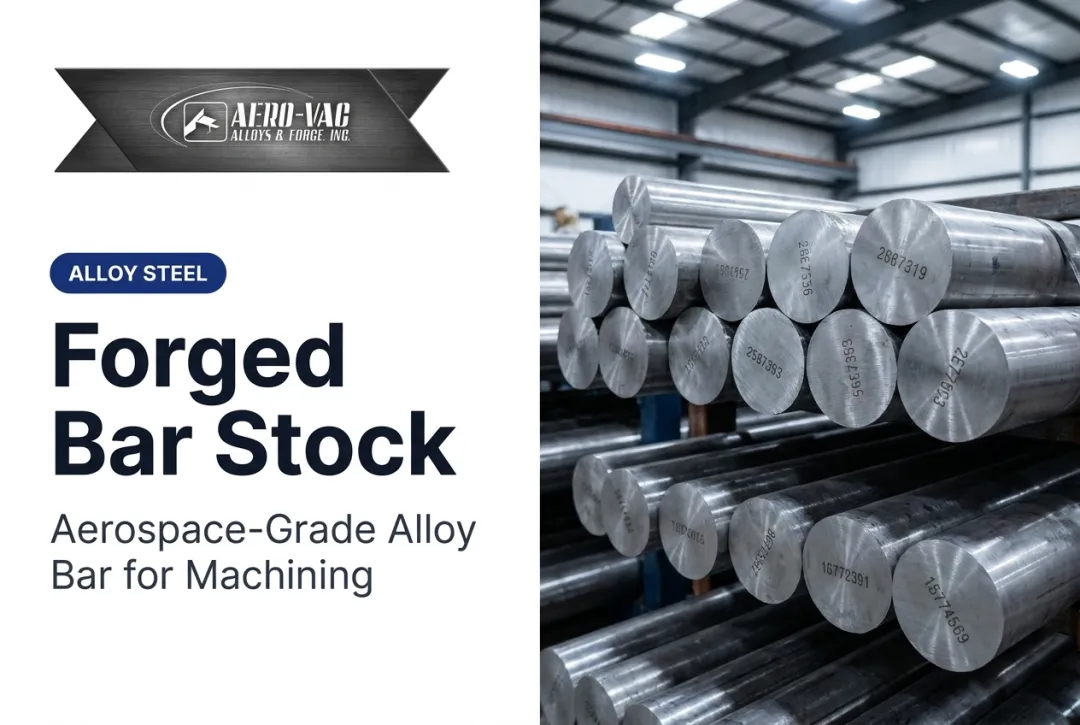
Raw-material quality drives performance just as much as alloy choice. Fine-grain bar stock and proper reduction ratios during forging determine whether the finished part meets its design strength.
Nickel 718, for example, requires initial forging temperatures capped near 2,050°F and at least a 25% reduction in the final forging step to avoid duplex grain structure.

Aero-Vac Alloys & Forge stocks these material families across multiple certified specifications, including:
- Ti-6Al-4V titanium under AMS 4928 and MIL-T-9047, in bar, block, and die-forging forms
- Inconel 718 under AMS 5662 as bars, forgings, and rings
- 7050 and 7075 aluminum plate and forgings under BMS7-323 and BMS7-186
- 300M and 4340 steel forging stock under BMS7-23 and related specs
With more than 150 aerospace-grade alloy specifications on hand and a rapid-response RFQ process, Aero-Vac supports OEMs and Tier 1 suppliers who need exact specs on just-in-time timelines. Orders range from small custom cuts to bulk production runs.
Key Applications of Forged Components in Aerospace
Forged parts show up wherever failure isn't tolerable:
Engine components:
- Turbine blades and discs
- Compressor rotors and discs
- Shafts, couplings, and manifolds
Landing gear and structural components:
- Axles, struts, and cylinders
- Hinge fittings and wing brackets
- Bulkheads, wing roots, and spars
Additional applications:
- Fasteners and engine mounts
- Rocketry structural components
- Connectors across military, commercial, and space vehicle programs
Boeing's parts catalog, for example, lists a titanium-alloy forged brake-rod assembly for landing-gear use. In engines, airframes, and landing systems, forged components carry the cyclic stress and fatigue loads that determine whether a part lasts its full service life.

Quality Standards, Certifications, and Supply Chain Considerations
AS9100 and ISO 9001 certification aren't paperwork formalities. AS9100 builds on the ISO 9001 framework with aerospace-specific requirements around traceability, risk management, and configuration control. Suppliers without current, verifiable certification introduce risk that OEMs simply can't absorb on flight-critical parts.
When vetting a forging supplier or distributor, verify:
- Current AS9100/ISO 9001 certificate scope and site coverage
- OASIS database listing status for certification verification
- Material traceability documentation back to melt source
- Third-party testing capability (ultrasonic, magnetic-particle inspection)

Certification alone does not fix availability. Supply constraints haven't disappeared. A November 2025 industry report noted longer lead times for new or custom forging presses and hammers, pushing some forgers to revitalize idle equipment rather than wait on new capacity. Reshoring pressure and tariff-driven sourcing shifts only add to that strain.
This is where a certified distributor earns its keep. Aero-Vac Alloys & Forge pairs AS9100-certified quality management with processing depth that shortens the path from stock to ship-ready material:
- In-house saw cutting, machining, and forging
- Coordinated heat treatment through NADCAP-partnered providers
- Independent third-party testing, including MIL-STD-2154 ultrasonic and AMS 2301 magnetic-particle inspection
Inventory depth, technical expertise, and fast procurement help OEMs and Tier 1 suppliers cut lead-time risk without sacrificing traceability.
Frequently Asked Questions
What is the difference between forging and casting in aerospace manufacturing?
Forging shapes metal under compressive force, aligning grain flow for higher strength. Casting pours molten metal into a mold, which can introduce porosity and grain segregation. Forging suits high-stress parts; casting suits complex, lightweight shapes.
Why is forging preferred for critical aerospace components?
Forged parts show higher tensile, fatigue, and yield strength than cast equivalents, thanks to worked grain structure and reduced porosity. That consistency matters when a component's failure would ground an aircraft.
What metals are commonly used in aerospace forging?
Common choices include titanium (Ti-6Al-4V), nickel superalloys such as Inconel 718, aluminum alloys (7075, 7050), and high-strength steels (AerMet 100, 300M). Each is selected for specific strength, weight, or heat requirements.
What certifications should an aerospace forging supplier or distributor have?
AS9100 and ISO 9001 are the baseline. AS9100 builds on ISO 9001 with aerospace-specific traceability and quality requirements, and status should be verified through the IAQG's OASIS database.
What is the difference between open die and closed die forging?
Open-die forging uses simple, unenclosed tools for large or simpler shapes like shafts and rings. Closed-die forging encloses the workpiece in a precision cavity, producing complex, tight-tolerance parts like turbine blades.
How long does it typically take to produce aerospace forged parts?
Lead times vary by part complexity, alloy, and current press capacity, and industry-wide constraints have stretched timelines for custom tooling. Working with a distributor such as Aero-Vac Alloys & Forge that holds forging-grade stock shortens that wait considerably.