
Yet many engineers and procurement teams struggle just to find a reliable source for certified forged alloy steel and specialty metals. Specs get lost in translation. Lead times stretch. Traceability paperwork shows up incomplete, which is a real problem when your end customer is Boeing or the Department of Defense.
This guide breaks down what commercial forged products actually are, the four main forging methods, why forged beats cast or machined in critical applications, and how to vet a supplier before you commit a purchase order.
Key Takeaways
- Forging aligns metal grain structure, delivering superior strength and fatigue resistance compared to casting or machining
- Aerospace, defense, oil & gas, power generation, and heavy trucking rely on forged components for high-stress, safety-critical performance
- Four forging methods exist: open-die, closed-die, ring rolling, and cold forging, each suited to different part geometries
- Suppliers with active ISO 9001:2015 and AS9100 certifications provide the traceability critical programs require
What Are Commercial Forged Products?
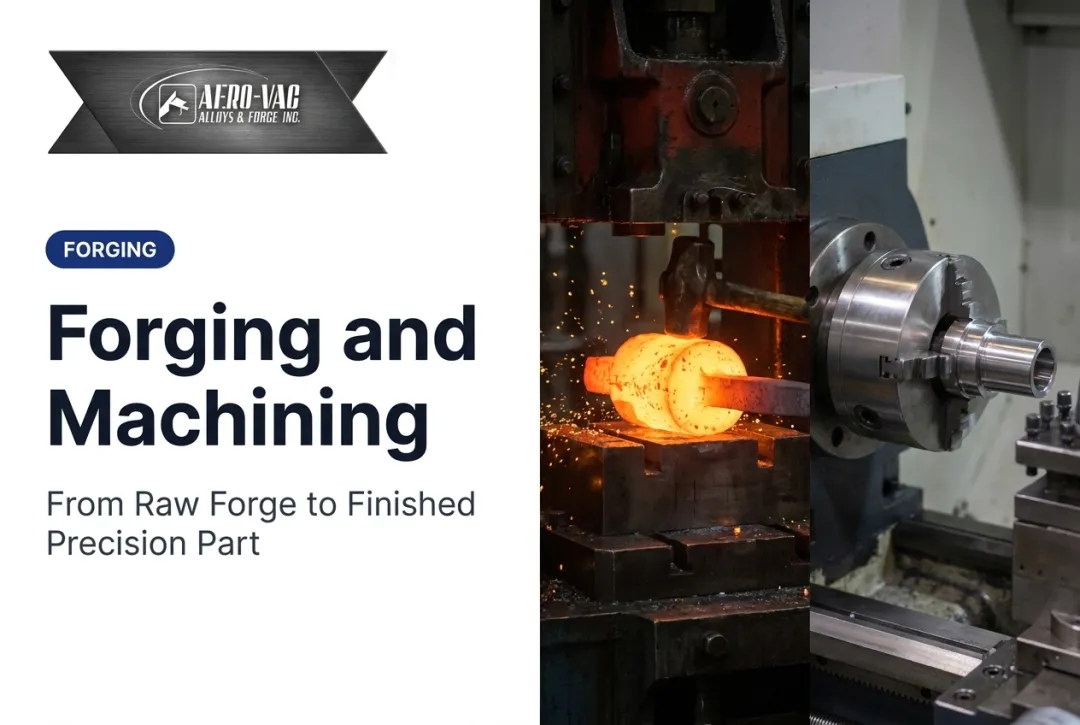
Forging shapes metal using compressive force, hammering, pressing, or rolling, typically while the material is heated to improve workability. The compressive force refines the internal grain structure, which is why forged parts outperform cast alternatives in demanding service.
Forged vs. cast vs. machined parts:
- Cast parts are poured into a mold as liquid metal, resulting in a random grain structure and more internal porosity risk.
- Machined parts are cut from bar or plate stock, which preserves the original grain but adds no additional strength.
- Forged parts compress and align grain flow along the part's shape, boosting tensile strength and fatigue life.

Common commercial forged products include:
- Shafts and gears
- Bearings and rings
- Flanges and pipe fittings
- Fasteners
- Structural aircraft components
Forging is a mature US manufacturing sector. The Forging Industry Association (FIA) counts more than 200 North American member companies, with producer members representing an estimated 75% of custom-forging volume.
Forged parts show up throughout critical assemblies, from aircraft structures to engines to drilling equipment, anywhere a single point of failure isn't an option.
What Are the Four Types of Forging?
Not every forging process suits every part. Matching the method to your project's geometry, volume, and tolerance needs saves both money and lead time.
Open-Die Forging
Metal is hammered or pressed between flat, V-shaped, or contoured dies without fully enclosing the workpiece. The Forging Industry Association (FIA) notes this method handles parts ranging from a few pounds to more than 300 tons. It's the go-to choice for large, custom, low-volume shapes like turbine shafts.
Closed-Die Forging
Also called impression-die forging, this method shapes metal within a fully enclosed die cavity. It delivers tighter dimensional control than open-die work, making it ideal for repeated, near-net-shape parts where tooling investment pays off over volume.
Ring Rolling
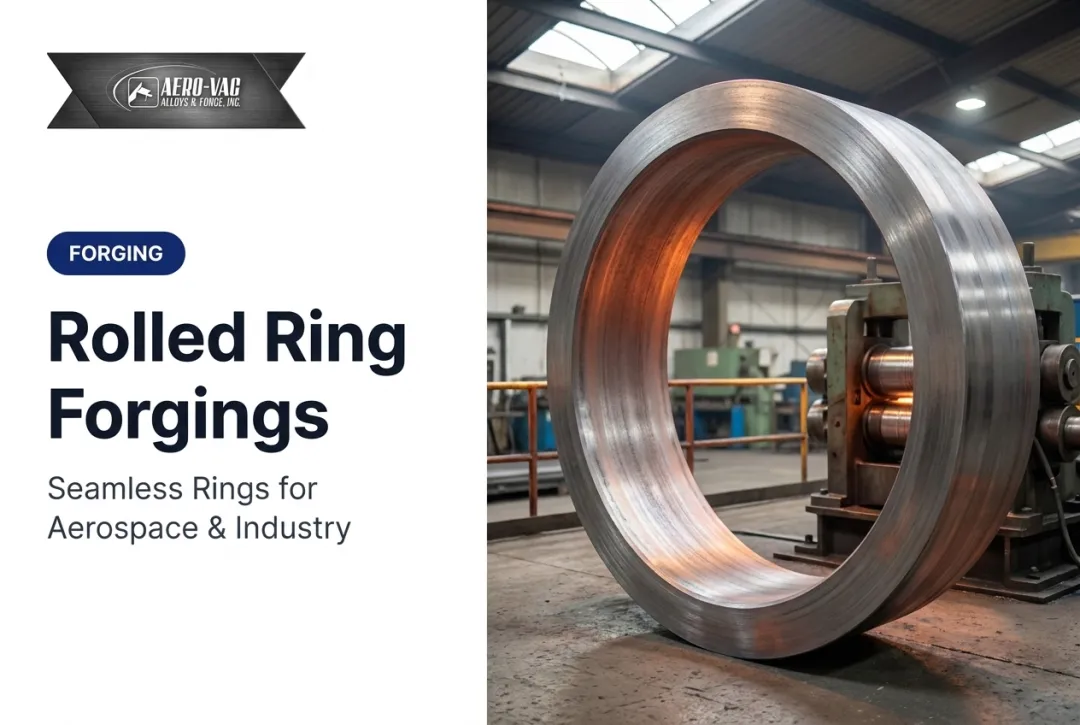
A disk preform is pierced through the center, then rolled into a seamless ring. FIA confirms this process produces no flash and needs little to no finish machining. Bearings, flanges, and structural rings all benefit from the weld-free strength this method provides.
Cold Forging
Cold forging runs at or near room temperature and work-hardens the metal as it deforms, increasing strength with each pass. It suits smaller, high-volume precision parts and produces a superior surface finish compared to hot forging.
Bottom line: open-die and closed-die trade off custom sizing versus tight tolerances, ring rolling wins for seamless round parts, and cold forging fits high-volume precision work.

Why Choose Forged Products Over Cast or Machined Alternatives
Grain flow is the whole story here. When metal is forged, the compressive force aligns internal grain along the part's contours instead of leaving it random, as casting does.
The data backs this up. A widely cited SAE technical paper compared forged-steel and ductile-cast-iron crankshafts under fatigue testing. For a given bending-moment amplitude, the forged-steel crankshaft delivered six times the fatigue life of its cast counterpart.

The Forging Industry Association (FIA) is blunt on the point: casting cannot replicate the strengthening effects of hot and cold working, and forging refines defects carried over from cast ingots or continuously cast bar.
Machining from bar or billet solves a different problem—and creates another. Cutting removes material and severs grain flow instead of shaping it, which means more scrap and weaker load paths at critical sections. Forging forms a near-net shape while keeping continuous grain along the contours that actually carry stress.
That's why forged components dominate where safety margins can't be negotiated:
- Aerospace landing gear and structural fittings
- Defense vehicle drivetrains
- Nuclear reactor internals
- Heavy-equipment and power-generation drivetrain components
The trade-off: forging typically costs more upfront and takes longer than casting because of tooling and process steps. For a one-off decorative bracket, that premium isn't worth it. For a landing gear trunnion, it's non-negotiable.
Key Industries and Applications for Commercial Forged Products
Forged components show up wherever load, heat, or corrosion pushes materials to their limits.
| Industry | Example Application | Why Forging Matters |
|---|---|---|
| Aerospace | Landing gear forgings in 300M or Aermet 100 alloy | Handles repeated high-stress landings without failure |
| Oil & gas | Nonmagnetic drill collars for directional drilling | Withstands downhole stress and corrosive fluids |
| Power generation | Turbine-generator shafts in 4340 alloy steel | Survives continuous rotational load at high temperature |
| Motorsports | Forged crankshafts for high-performance engines | Delivers fatigue life that cast crankshafts can't match |
Material selection tracks directly with service conditions:
- Drill collars need corrosion and stress-corrosion resistance
- Turbine shafts need high-temperature strength
- Racing crankshafts need fatigue resistance under repeated cycling
There's no universal "best" alloy, only the right alloy for the load, temperature, and environment the part will face.
Materials Commonly Used in Commercial Forging
Alloy choice drives everything downstream: cost, weight, corrosion resistance, and how the part behaves under stress.
- Carbon steel – Good baseline strength for piping components and general structural forgings (ASTM A105/A105M covers piping applications)
- Alloy steel – Grades like 4340 and 4140 add hardenability for shafts, gears, and high-load structural parts
- Stainless steel – Corrosion resistance for bearings, fittings, and high-temperature pressure parts (ASTM A182/A182M governs pipe flanges and fittings)
- Nickel-based superalloys – Alloys such as 625 and Waspaloy hold strength at extreme temperatures, common in jet engines and power turbines
- Titanium – Strength-to-weight ratio that's hard to beat for aerospace structures (ASTM B381 covers titanium forgings across 39 grades)
- Aluminum alloys – Lightweight option for airframe components where corrosion resistance and low density matter more than high-temp strength
Aero-Vac Alloys & Forge stocks alloy grades spanning these categories, including 4340 steel, AMS 5644 stainless, and nickel alloy 625. Material is sourced against the exact specification your program calls for rather than a generic equivalent.

How to Choose the Right Supplier for Commercial Forged Products
Picking a forging supplier isn't just about price per pound. Certification, traceability, and responsiveness matter just as much, especially when your end customer audits your supply chain.
Certifications That Actually Matter
Look for active ISO 9001:2015 certification (the 2008 revision was withdrawn back in 2015) and AS9100 for aerospace and defense work. AS9100 builds on ISO 9001 with additional traceability and material-identification requirements specific to aviation, space, and defense programs.
Beyond the certificate itself, ask your supplier to demonstrate:
- Heat and lot identity tracking from raw material through processing
- Retained material certs, heat-treatment records, and inspection reports
- Active status verification (not just a certificate on file)
Service Flexibility Matters Just as Much
A certification means little if the supplier can't actually deliver. Aero-Vac Alloys & Forge, an AS9100-certified manufacturing distributor based in Kalama, Washington, is one example. The company works with Boeing, Lockheed, General Electric, and Caterpillar by pairing certified quality systems with practical sourcing support.
What that looks like day to day:
- A live person on the phone for custom cuts and odd sizes, not a call center script
- Just-in-time delivery backed by order tracking through processing and shipment
- Flexibility for both small trial orders and large production runs
- In-house saw cutting and machining, plus heat treatment through a hybrid in-house/NADCAP-partner model

If you're sourcing forged alloy steel, stainless, or nickel superalloys for a critical program, choose a partner who operates as an extension of your own quality team.
Frequently Asked Questions
What are commercial forged products?
Commercial forged products are metal components shaped using compressive force, hammering, pressing, or rolling, typically while heated. They're used across aerospace, defense, oil and gas, and industrial equipment where strength and reliability are critical.
What are the four types of forging?
The four primary methods are open-die (custom large shapes), closed-die (precise high-volume parts), ring rolling (seamless round components), and cold forging (room-temperature, high-precision small parts). Each fits different volume and tolerance needs.
What industries rely most on forged parts?
Aerospace, defense, oil and gas, and power generation are the heaviest users of commercial forgings. Motorsports and heavy trucking also depend on forged components for fatigue-critical parts like crankshafts and axles.
How do forged parts differ from cast parts?
Forging compresses and aligns the metal's grain structure along the part's shape, boosting strength and fatigue resistance. Casting produces a random grain structure with more porosity risk, making it less suited to high-stress applications.
What certifications should a forging supplier have?
Look for active ISO 9001:2015 registration and AS9100 certification for aerospace and defense work. These confirm the supplier maintains documented quality systems and material traceability throughout processing.
How do I choose the right metal for a forged component?
Material choice depends on the part's load, operating temperature, and environmental exposure. A drill collar needs corrosion resistance, while a turbine shaft needs high-temperature strength, so match the alloy to the actual service condition.