
The US Machine Shop Services industry sits at $46.3 billion in 2026, though it's seen a slight 0.2% CAGR decline since 2021. Even so, demand for certified, tight-tolerance turning capacity hasn't slowed for aerospace and medical buyers who need parts that pass audits the first time.
This guide ranks ten manufacturers worth your attention in 2026, plus what to check before you sign a purchase order.
TL;DR
- CNC turning spins the workpiece on a lathe while a fixed tool cuts shafts, pins, fasteners, and connectors
- Choose shops by certifications, tolerance capability, and material range—not brand name
- This list ranks ten US CNC turned parts manufacturers for 2026 by certification, technical capability, and industry trust
- Vet certified alloy bar suppliers alongside machine shops to secure just-in-time material for turning programs
Overview of CNC Turned Parts Manufacturing in the US Market
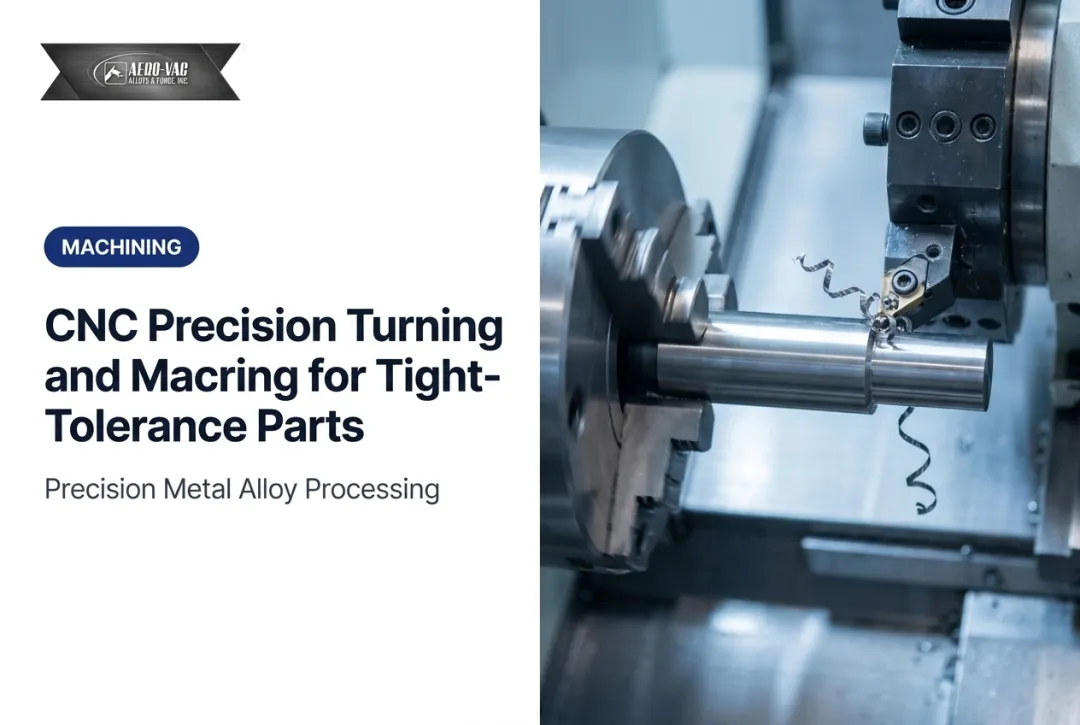
CNC turning is simple: the workpiece rotates on a lathe while a stationary cutting tool removes material to create cylindrical geometry. CNC milling works the opposite way: the part stays fixed while rotating tools cut it, which is why milling handles flat faces, pockets, and irregular shapes better than turning does.

Turned parts show up everywhere:
- Aerospace fasteners and fittings
- Medical device pins and connectors
- Automotive shafts and axles
- Electronic connector housings
According to PMPA's turning-versus-milling explainer, roughly 60% of turned parts need a secondary operation afterward, such as slots, grooves, or bolt holes. For buyers, that means a turn-only shop may not be the best fit if your part needs cross-drilling or milled features.
Below, we rank ten manufacturers based on certifications (ISO 9001, AS9100, ISO 13485), tolerance capability, material range, and industry track record.
Top 10 CNC Turned Parts Manufacturers in the USA
Each shop below earned its spot through documented certifications, tight tolerance capability, and proven experience across aerospace, defense, medical, and industrial sectors.

1. Pioneer Service Inc.
Based in Hodgkins, Illinois, Pioneer Service specializes in CNC Swiss machining and precision turned parts. The shop holds outside diameters within ±0.0001 in and achieves surface finishes as fine as 6 micro-inches RMS. That precision matters for tight-fit assemblies.
| Certifications | Technical Specs | Key Features |
|---|---|---|
| AS9100:2016, ISO 9001:2015 | OD tolerance ±0.0001 in; 6 µin RMS finish | Steel alloys, stainless, tool steel, aluminum, brass, nickel alloys |
2. Allied Technologies International
Located near Portland, Oregon, Allied Technologies runs 7-axis Swiss-machined production and precision-formed stainless fasteners. Its FDA registration and ITAR compliance make it a strong fit for orthopedic and defense-adjacent programs.
| Certifications | Technical Specs | Key Features |
|---|---|---|
| ISO 13485, AS9100D, ISO 9001:2015 | 7-axis Swiss machining | FDA registered, ITAR compliant; orthopedic, aerospace, telecom markets |
3. Swissturn USA, Inc.
Swissturn, headquartered in Oxford, Massachusetts, produces Swiss CNC components between 0.010 and 1.250 in in diameter and up to 12 in long. CMMC compliance signals it's built for defense supply chains handling controlled information.
| Certifications | Technical Specs | Key Features |
|---|---|---|
| ISO 9001:2015, ITAR registered, CMMC compliant | Diameters 0.010–1.250 in; lengths up to 12 in | Medical, aerospace, defense, photonics, industrial OEMs |
4. H & R Screw Machine Products, Inc.
This screw and Swiss machining shop offers turning capacity up to 8 in, serving a diverse customer base from medical device makers to heavy equipment manufacturers.
| Certifications | Technical Specs | Key Features |
|---|---|---|
| ISO 9001:2015 | Turning capacity up to 8 in | Aluminum, brass, bronze, stainless, steel; medical, military, HVAC markets |
5. Precision Turning Specialties
Operating out of Greeneville, Tennessee, this shop routinely holds tolerances of 0.0005 in or less on turned diameters ranging from 0.093 to 2 inches. That capability suits aerospace and RF connector work.
| Certifications | Technical Specs | Key Features |
|---|---|---|
| AS9100, ISO 9001:2015 | Diameters 0.093–2 in; tolerance ≤0.0005 in | Aluminum, brass, copper, stainless, plastics; aerospace, medical, RF, defense |
6. Fairchild Precision Parts
In business since 1944, this Winsted, Connecticut shop specializes in high-volume Swiss and CNC turning with a stated tolerance of ±0.0001 in, among the tightest on this list.
| Certifications | Technical Specs | Key Features |
|---|---|---|
| AS9100 Rev D, ISO 9001:2015 | Tolerance ±0.0001 in | T303 stainless, 6061-T6 aluminum; aerospace, defense, fluid control |
7. Parts Tool & Die, LLC
This Agawam, Massachusetts shop stands out for large-diameter turning capability, handling parts up to 36 in. That's unusual capacity, useful for oil and gas or heavy commercial applications beyond typical small-part turning.
| Certifications | Technical Specs | Key Features |
|---|---|---|
| ISO 9001, AS9100, ITAR compliant | Turning up to 36 in diameter | Inconel, magnesium, titanium, stainless, nickel, brass |
8. Hirsh Precision Products
Located in Frederick, Colorado, Hirsh runs traditional turning, Swiss lathes, and mill-turn setups for both low- and high-volume runs. Its ISO 13485 certification and FDA registration make it a natural fit for medical device programs.
| Certifications | Technical Specs | Key Features |
|---|---|---|
| ISO 13485:2016, AS9100D, FDA registered | Mill-turn capable; low- and high-volume | Metals, plastics, medical-grade plastics; biotech, medical, aerospace |
9. Cox Manufacturing Company
Based in San Antonio, Texas, Cox runs Swiss CNC turning at high volume, with a materials list that stretches from aluminum to titanium and plastics, one of the broadest ranges among shops on this list.
| Certifications | Technical Specs | Key Features |
|---|---|---|
| ISO 9001:2015 | High-volume Swiss screw machining | Aluminum, titanium, special alloys, plastics; firearms, energy, medical markets |
10. Winslow Automatics Inc.
Winslow, headquartered in New Britain, Connecticut, turns exotic alloys including Inconel, Hastelloy, and Waspaloy. It's a strong option when your part spec calls for materials most shops won't touch.
| Certifications | Technical Specs | Key Features |
|---|---|---|
| AS9100 certified | Handles superalloys and titanium | Aluminum, Inconel, Hastelloy, Waspaloy; aerospace, defense, energy |
How We Chose the Best CNC Turned Parts Manufacturers
Buyers often default to the lowest quote without checking certifications or tolerance history first. That mistake shows up later, in rework, in scrap, or in a failed customer audit.
We evaluated each shop against five factors:
- Certifications (ISO 9001, AS9100, ISO 13485) : confirms an active quality management system, not just a claim on a website
- Tolerance precision : matches part specs to shop capability before quoting
- Material versatility : checks whether a shop actually machines your alloy family regularly
- Production scalability : separates prototype-only shops from those built for repeat volume
- Industry track record : verifies years in aerospace, medical, or defense specifically, not general manufacturing
Getting these right up front reduces scrap rates and shortens time-to-market, which matters more than a slightly lower per-unit quote.

Sourcing the Right Alloy Stock for Your CNC Turning Project
A turned part is only as good as the bar stock it started as. Inconsistent alloy composition or missing traceability documentation can cause a part to fail inspection even when the machining itself was flawless.
That's why OEMs and machine shops alike lean on certified metal distributors rather than gambling on unverified sources.
Aero-Vac Alloys & Forge, Inc. is one of those partners: an ISO 9001 and AS9100-certified manufacturing distributor supplying alloy steels and specialty metals for turning programs across aerospace, defense, medical, and industrial applications. Common turning-stock grades in the catalog include:
- 4130 and 4140 bars and forgings
- 4340 and 300M/4340M bars, plates, and tubing
- 9310/9310V carburizing-grade bar and forging stock
- Stainless grades including 304L, 17-4PH, and 15-5PH
Aero-Vac has supplied material to companies including Boeing, SpaceX, and Lockheed.
Beyond raw stock, the company offers in-house saw cutting to prep bar stock before it reaches your turning shop. Small custom cuts and large bulk orders are both in scope.

A live support team helps buyers lock exact specifications instead of waiting on generic mill lead times.
Conclusion
The right CNC turning partner is the one whose certifications and tolerance capability match your part's requirements. A well-known name alone is not enough.
Before committing to a long-term supplier, verify:
- On-time delivery record
- Defect rates
- How non-conformances are handled when something goes wrong
Once the machine shop is set, material supply still has to keep pace. If you're sourcing certified alloy stock for a turning program, Aero-Vac Alloys & Forge can help with material selection and just-in-time delivery.
Frequently Asked Questions
Where can I find wholesale CNC turning parts?
Start with ISO-certified manufacturers offering CAD-based quoting and proven high-volume capacity. Compare domestic and offshore shops on unit cost, then factor in lead time and quality control.
What are CNC turned parts?
CNC turned parts are cylindrical precision components made on computer-controlled lathes. Common examples include shafts, pins, bushings, and connectors used across aerospace, medical, and industrial equipment.
What is the difference between CNC turning and milling?
Turning rotates the workpiece against a fixed cutting tool to create cylindrical shapes. Milling holds the workpiece still while the cutting tool rotates, making it better suited for flat faces and complex geometries.
How do I calculate CNC turning cost?
Cost depends on material, cycle time, tolerance requirements, order volume, and finishing needs. Request a detailed quote based on your drawing rather than relying on generic per-part estimates.
What certifications should a CNC turned parts manufacturer have?
Look for ISO 9001 as a baseline quality-management standard, AS9100 for aerospace work, and ISO 13485 for medical device applications. Match the cert to your end-use industry and any customer audit requirements.
What materials are commonly used in CNC turned parts?
Aluminum, steel, stainless steel, brass, and titanium are the most common. Choose based on your drawing specs, required strength or corrosion resistance, and operating environment.