
Buyers in these industries face real friction. Sourcing traceable alloy stock takes time. Meeting tolerances measured in ten-thousandths of an inch requires the right equipment and the right material. And finding a supplier who'll handle a single custom cut as readily as a bulk order isn't as easy as it sounds.
This guide breaks down what precision machining actually is, how components get made, which materials perform best under stress, which industries rely on this work, and what drives cost. We'll also cover how to choose a metal supplier who won't slow down your production line.
Key Takeaways
- Tight-tolerance CNC milling, turning, grinding, and EDM deliver the repeatability precision parts require
- Certified material quality drives final performance as much as the machining process
- Aerospace, defense, medical, and power generation programs need certified, fully traceable suppliers
- Choosing an ISO 9001/AS9100-certified metal distributor cuts sourcing risk and lead-time delays
What Is Precision Machining?
Precision machining is subtractive manufacturing—removing material from a workpiece as chips or swarf to reach a defined geometric shape. That matches how NIST defines machining. Precision and accuracy are not the same thing.
Accuracy is how close a part comes to its target dimension. Precision is how consistently a process repeats that result across runs, per NIST's metrology terminology. A shop can run precise and still miss the target, or hit the target once and fail to repeat it. Production work needs both.
A precision machined part must hold consistent dimensions whether it's the first unit off the line or the ten-thousandth. That consistency is what aerospace and defense contracts demand.
The market reflects that demand. Grand View Research projects the US precision machining market will grow from $23.6 billion in 2025 to $37.1 billion by 2033, a 5.9% annual growth rate.
Common Precision Machined Components
Precision machining touches nearly every mechanical assembly. Common outputs include:
- Fasteners and threaded connectors
- Gears and gear trains
- Bearings, including specialty bearing-steel components
- Valves for hydraulic and pneumatic systems
- Electrical and structural connectors
- Forged steel components for structural or load-bearing use
None of these start as finished parts. They start as raw alloy stock. Aero-Vac Alloys & Forge supplies the bar, plate, and forging stock—in specs such as 4340, 300M, and M-50 bearing steel—that machine shops machine to the tolerances those assemblies require.
How Are Precision Machined Components Made?
Four subtractive processes account for most precision machined parts:
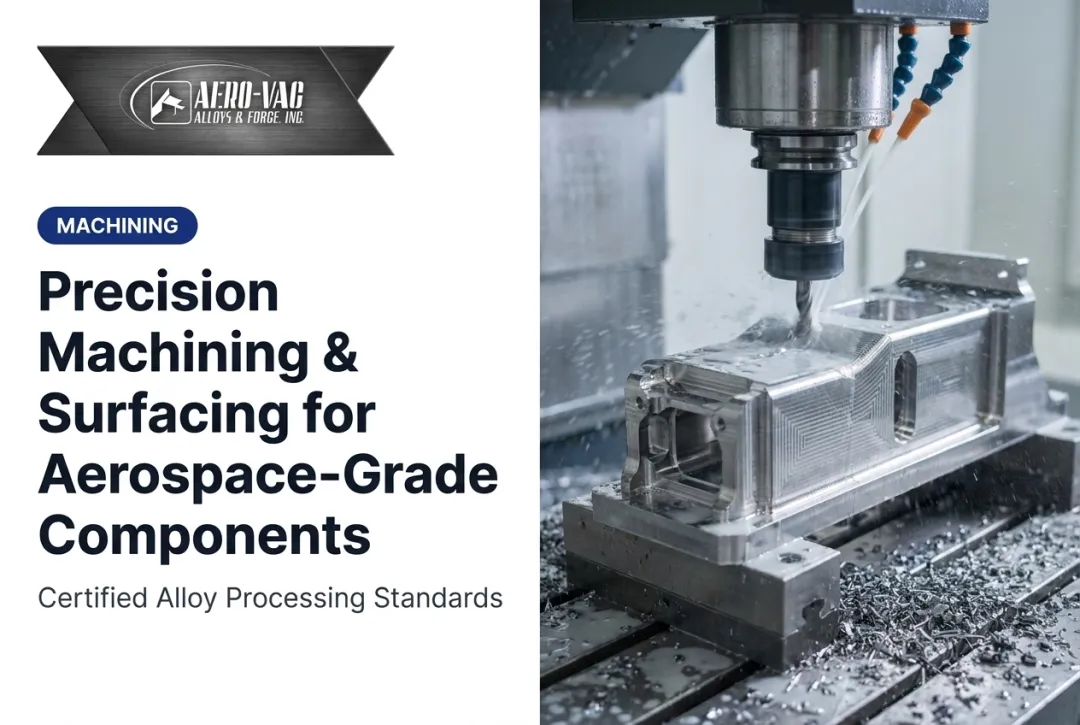
- CNC milling: Automated cutting tools remove material in controlled, pre-programmed passes, per Fictiv's description
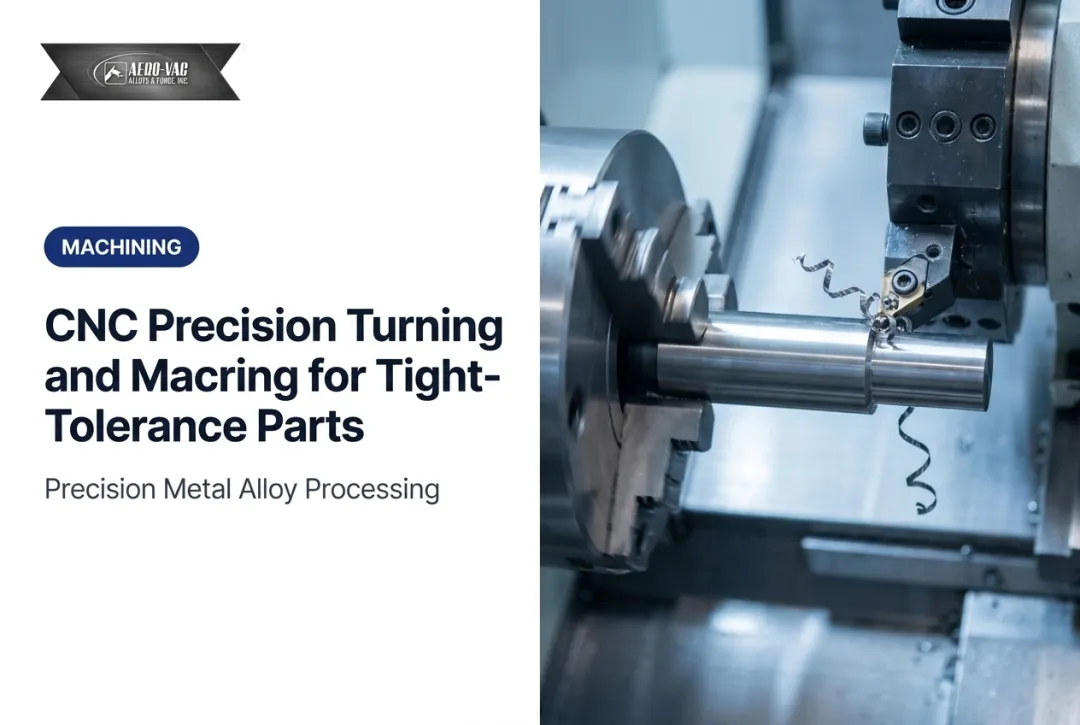
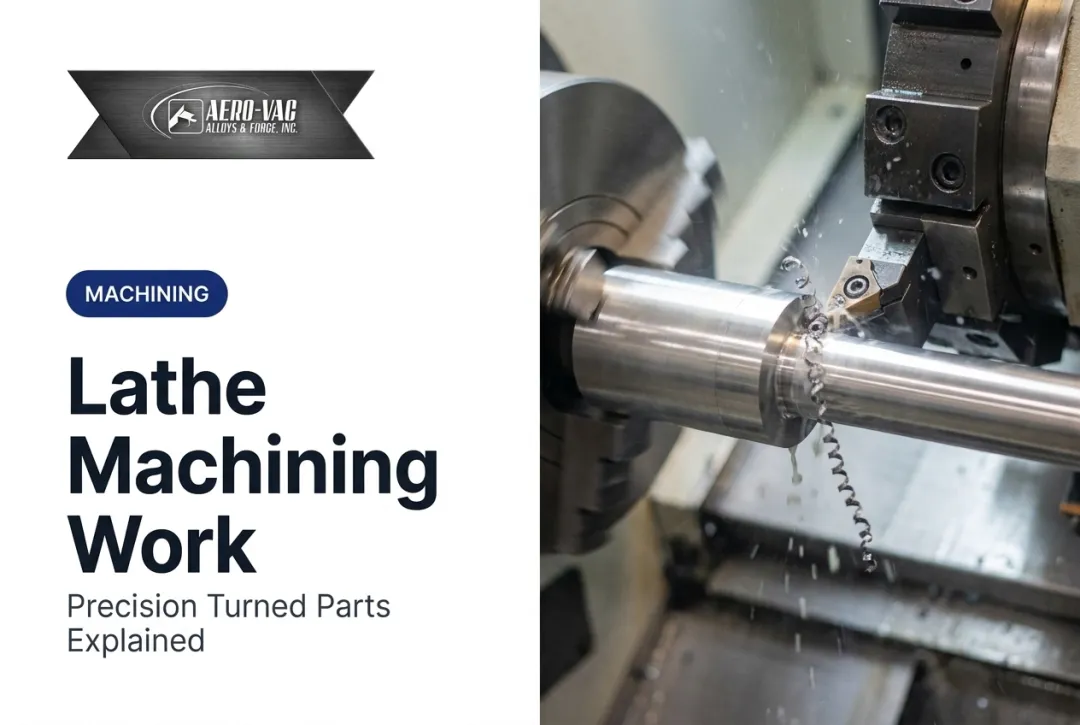
- CNC turning: The workpiece rotates on a lathe while a cutting tool moves linearly, shaping cylindrical parts, as Xometry explains
- Grinding: A rotating abrasive wheel removes material for fine surface finishes
- EDM (electrical discharge machining): Electrical discharges between an electrode and workpiece, separated by dielectric fluid, erode material without physical cutting force

Quality Control Is the Foundation
None of these processes matter without quality infrastructure behind them:
- Trained machinists who understand tolerance stack-up
- Calibrated measurement systems (CMMs, micrometers, gauges)
- Certified quality management under ISO 9001 or AS9100
Raw material quality directly impacts a machinist's ability to hit tolerance. Inconsistent alloy composition or unverified heat-treatment condition causes scrap and rework long before a part reaches final inspection. That's why traceable material certifications matter as much as the CNC program itself.
Multi-axis CNC machines reduce tolerance stack-up risk further. A 5-axis setup can cut a part from multiple angles without re-fixturing, so repositioning errors never compound. With preventive maintenance and experienced operators, shops hold those same tight tolerances across high-volume runs—not only on a single prototype.
Best Materials for Precision Machining
Material choice determines whether a part survives its application. Here's why four categories dominate high-stress, high-precision work:
| Material | Why It's Chosen |
|---|---|
| Alloy steel (like 4140) | Exceptional toughness, strength, wear resistance for structural parts |
| Stainless steel | Corrosion resistance from its alloy composition, per ASM International |
| Titanium alloys | Lightweight paired with corrosion resistance, ideal for aerospace |
| Superalloys | Withstand extreme heat in turbines, reactors, and aircraft skins |

Certification prevents rejected parts. Mill certs and material traceability documentation confirm that the alloy in hand matches the spec on the drawing. Skip this step, and you risk machining a part to perfect tolerance out of the wrong chemistry, an expensive mistake to catch after the fact.
This is where Aero-Vac Alloys & Forge fits into the supply chain. The company stocks exact-spec alloy steels, stainless grades like 17-4PH and 15-5PH, and titanium 6Al-4V under AMS 4928, along with less common sizes that machine shops often struggle to source elsewhere.

A live person handles quoting and odd-size requests directly, rather than routing buyers through automated systems.
Order flexibility matters too. Whether a machine shop needs a single custom-cut bar or a bulk forging order for a production run, just-in-time delivery keeps projects moving without forcing customers into mill-scale minimum orders or long distributor lead times.
Industries That Depend on Precision Machined Components
Aerospace and Defense
Flight-critical parts demand AS9100 compliance from the first cut through final inspection. Common examples include:
- Engine components
- Structural brackets
- Flight control parts
The IAQG 9100:2016 standard governs quality management across the aviation, space, and defense supply chain, adding requirements on top of ISO 9001.
Medical and Power Generation
Implantable devices demand full material traceability. The FDA's Quality Management System Regulation, effective February 2026, incorporates ISO 13485:2016 and applies to finished-device manufacturers.
Power generation faces the same traceability bar. Nuclear reactor components fall under the 2025 ASME Boiler and Pressure Vessel Code, which sets quality assurance rules for nuclear facility component manufacturers and material suppliers.
Heavy Industry
These sectors start with forging-grade steel and tight material controls:
- Oil and gas equipment
- Motorsports components
- Heavy trucking parts
- Bearings
API Spec 6A sets chemical composition, mechanical property, and full material-traceability requirements for oilfield equipment.
Aero-Vac Alloys & Forge supplies forging-grade alloys and certified mill specs used across these programs—including work for customers such as Boeing and Westinghouse—so machined parts inherit the documentation aerospace, nuclear, power generation, and heavy industry buyers require.

How Much Does Precision Machining Cost?
Precision machining cost is almost always quote-specific, but four factors drive most of the variation from job to job:
- Material type: Harder, less-machinable alloys require specialized tooling and longer cycle times
- Tolerance requirements: Tighter tolerances mean slower feeds, more inspection, and pricier setups
- Part complexity: Complex geometry adds toolpaths, fixturing, and setup time
- Order volume: Larger runs spread fixed setup costs across more parts, lowering the per-unit price
Lead time raises cost too. Rushed jobs often mean overtime labor and expedited material sourcing, both of which add to the bill.
Sourcing certified raw material efficiently cuts overall project cost. A shop waiting weeks on a mill for a small custom cut loses money sitting idle. A distributor that already stocks the spec—or can process and forge it quickly—keeps the schedule and the budget on track.
Frequently Asked Questions
What is precision machining?
Precision machining is a subtractive manufacturing process that removes material from a workpiece to achieve tight, repeatable tolerances. It relies on CNC-controlled equipment to hold consistent dimensions across production runs.
What are precision machined components?
Precision machined components are parts built to exact dimensional specs for functional or assembly-critical use. Common examples include fasteners, gears, bearings, valves, and connectors in aerospace, defense, and industrial equipment.
What are the different types of precision machining?
The main processes are CNC milling, CNC turning, grinding, and EDM (electrical discharge machining). Each suits different geometries, materials, and tolerance requirements.
What does a precision machinist do?
A machinist programs, operates, and inspects CNC equipment so finished parts match engineering drawings. The role mixes blueprint reading, shop-floor math, and CNC programming skill.
How precise are most CNC machines?
Precision varies by process and equipment; it's not a single universal number. Wire EDM systems, for example, can achieve accuracy within a few microns, with some specialized machines reaching even tighter tolerances.
How much does it cost to get parts machined?
There is no flat rate—price tracks material grade, tolerances, geometry complexity, and order volume. Getting certified stock without mill delays is often one of the biggest levers on total project cost.