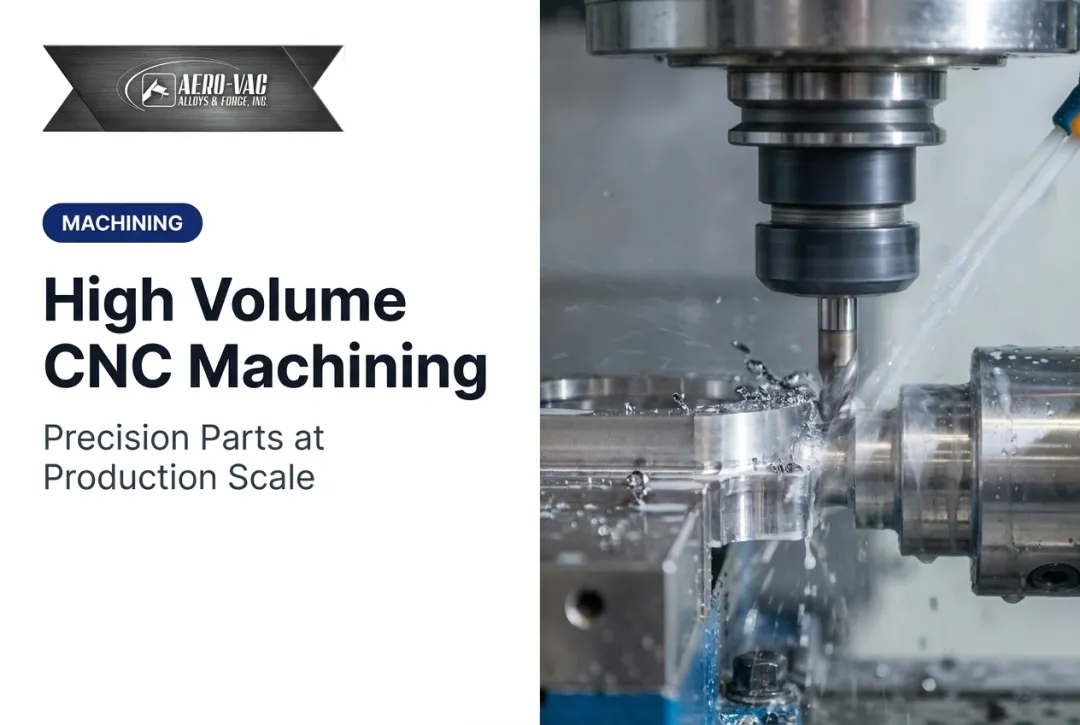

Many programmers assume the machine is the limiting factor. Often it's the material. Inconsistent hardness or composition variation causes chatter and unpredictable tool wear at exactly the speeds where HSC should shine.
This guide breaks down what defines HSC, the mechanics behind it, where it delivers real advantages, where it fails, and why the alloy stock feeding your program matters as much as your spindle specs.
Key Takeaways
- HSC relies on lighter, faster cuts rather than fewer heavy passes
- Shorter cycle times, better surface finish, and longer tool life when parameters are dialed in correctly
- Material consistency and certification directly affect how safely a shop can push speeds
- Not every job benefits from HSC — machine rigidity and part geometry set real limits
- Sourcing from a certified alloy distributor cuts the risk of material-related scrap
What Is High Speed CNC Machining?
There's no single RPM number that defines high-speed CNC machining (HSC). Modern Machine Shop has documented HSC applications running at just 4,000 RPM, while other reported setups push past 60,000 RPM. Spindle speed alone doesn't make a process "high speed" — the discipline is about optimization, not a threshold.
In practice, most shops apply HSC principles somewhere in the 10,000–60,000+ RPM range, depending on tool diameter and material. HSC is defined less by RPM and more by how you cut:
- Replacing few heavy cuts with many light, fast passes
- Controlling chip thickness and heat instead of pushing volume per pass
- Maintaining stability and accuracy at speed, not just hitting a number on the readout
The Practical Definition
The practical definition ties together spindle speed, feed rate, and chip thinning. If your process uses reduced radial engagement to allow faster feeds while keeping chip load consistent — and the machine holds accuracy while doing it — you're running HSC, regardless of the exact RPM on the display.
HSC vs. conventional milling: Conventional milling takes heavier radial depths at lower speeds, generating more sustained heat and higher cutting forces. HSC uses shorter tool-material contact time per pass, which changes the entire heat and force equation — often producing a better surface finish with less secondary work.

The Mechanics Behind High Speed Machining
Chip Thinning and Feed Rates
Reducing radial depth of cut lets you push feed rates higher without overloading the cutting edge. This is radial chip thinning: with smaller radial engagement, the chip doesn't get too thick even as feed increases. That relationship is what makes high-speed cutting viable.
Calculating Spindle Speed with SFM
Setting the right spindle speed starts with surface feet per minute (SFM), calculated as:
SFM = (RPM × Tool Diameter × π) / 12
Kennametal's speeds and feeds calculator uses this relationship to calculate RPM for a target SFM. Treat those figures as starting points only—results shift with tool condition, coolant, and material behavior.
Toolpath Strategies That Keep Forces Constant
Two strategies dominate HSC programming:
- Trochoidal milling — a curved, slicing path with high axial depth and low radial width, typically capped around 0.2 tool diameters of radial engagement
- Adaptive clearing — keeps engagement constant through direction changes, avoiding the force spikes conventional pocketing paths create at corners
Heat Management and Machine Requirements
Shorter tool-material contact time in HSC means less sustained heat buildup compared to conventional milling's prolonged dwell. But this only holds if the machine can keep up. Rigidity, spindle balance, and CAM look-ahead features all matter:
- Rigidity — resists deflection when feed rates climb
- Spindle balance — limits vibration above roughly 20,000 RPM
- Look-ahead control — anticipates path changes so the machine does not lag

Why Material Selection Is Critical to High Speed Machining Success
Here's the part most HSC discussions skip: the alloy itself sets the ceiling on what speed and feed combination will actually work.
Inconsistent composition or hardness variation causes unpredictable tool wear and chatter — even when your CAM program and machine are dialed in perfectly. A batch of 4140 with hardness drifting outside spec will chew through tooling differently pass to pass, and you won't know until you're mid-run.
This is where sourcing matters as much as programming.
Certified, Traceable Material Reduces Guesswork
Working with material backed by mill certs and ISO 9001/AS9100 sourcing controls removes a major variable from the HSC equation. Aero-Vac Alloys & Forge is an AS9100 and ISO 9001:2008 certified distributor supplying alloy steels and forging materials for demanding aerospace and defense machining programs, including:
- AMS 6382 4140 alloy steel (approximately 0.95% chromium, 0.20% molybdenum) in bars and forgings
- AMS 6514 Maraging 300, a nickel-based maraging steel with 18.5% nickel and 9.0% cobalt, available as bars, forgings, and tubing
- ASTM A581/A581M free-machining stainless steel in wire and wire-rod form

Keeping Production Schedules on Track
High speed programs depend on schedule predictability. If you're waiting weeks for the right billet, your machine sits idle.
Aero-Vac checks existing inventory first and, when material isn't in stock, sources the exact specification quickly rather than forcing a substitution—so committed HSC schedules stay on track.
Advantages and Ideal Applications of High Speed Machining
When the parameters are dialed in, HSC delivers measurable gains:
- Reduced cycle time — die-and-mold work cut from 20 labor hours to 1 hour in a documented shop case
- Improved surface finish — reduces or eliminates secondary polishing operations
- Longer tool life — controlled engagement spreads heat more evenly across the cutting edge
One Modern Machine Shop case moved from conventional roughing at 900 RPM to HSC at 9,200 RPM and eliminated EDM entirely. That result is a single documented example, not a universal percentage, but it shows the ceiling when engagement control, material behavior, and machine capability align.
Best-Fit Applications
HSC is especially effective for:
- Thin-walled aerospace parts where excess heat or force would warp geometry
- Hardened tool steel and mold-die work, especially where EDM was the prior fallback
- High-volume aluminum production runs
- Complex 3D geometries that benefit from constant-engagement paths

Challenges and When Not to Use High Speed Machining
HSC is not the right fit for every job. Pushing it into the wrong application creates real problems.
Common Pitfalls
- Chatter and vibration from excessive radial depth of cut or worn tooling, which increases cutting forces
- Tool deflection, often from stick-out that is too long. Haas notes that a 10% reduction in tool length-to-diameter ratio increases stiffness by roughly 25%
- Machine limitations, including insufficient rigidity, capped spindle RPM, or a control lacking look-ahead processing
When to Skip HSC
- Bulk roughing of large steel blocks where material removal rate matters more than finish
- Loose-tolerance, high-volume simple parts where conventional milling is already fast enough
- Machines without look-ahead CNC capability, which can't process high-speed toolpaths without distorting the programmed path
Mitigation Steps
- Balance tooling assemblies dynamically, especially above 20,000 RPM
- Recalculate chip load before assuming higher RPM alone will fix a problem
- Ramp speeds incrementally rather than jumping straight to maximum RPM. Entry ramping at an angle reduces cutter force and vibration on initial engagement
Frequently Asked Questions
What is considered high speed machining?
HSM is defined by high spindle speeds paired with light, fast cuts while holding chip load and accuracy—not by a single RPM number. Documented applications sometimes run as low as 4,000 RPM when tool diameter and material demand it.
What is the SFM formula?
SFM = (RPM × Tool Diameter × π) / 12. That edge speed is what you convert back into spindle RPM for a given material and tool diameter.
Is high speed machining more expensive than conventional CNC machining?
It often requires more upfront investment in rigid machines and specialized tooling. However, reduced cycle time and fewer tool changes can lower per-part cost over a production run.
Does high speed machining work for all materials?
It works across aluminum, steel, titanium, and composites, but parameters must be tuned per material. Titanium, for example, work-hardens and generates heat quickly, requiring more conservative cutting speeds than aluminum.
How does material quality affect high speed machining outcomes?
Alloy consistency and certification directly affect tool wear predictability. Inconsistent hardness or composition causes chatter and scrap that no amount of CAM tuning can fully offset.
What RPM is considered the minimum for high speed machining?
RPM alone does not define HSM. Shops run documented jobs from about 4,000 RPM to over 60,000 RPM; material, tool diameter, and machine stiffness set the practical floor.