
The stakes are real. A 2017 heavy-truck axle study found that switching from a solid to a hollow shaft design delivered around 26% weight savings after load mapping and finite-element evaluation (ScienceDirect, 2017). That's meaningful mass reduction without giving up load capacity.
This guide breaks down how hollow forging works, the methods used, where it delivers the most value, and how to pick a materials partner that won't blow your project timeline.
Key Takeaways
- Hollow forging shapes tubular components around a mandrel, preserving grain flow that machining destroys
- Open-die and mandrel forging are the primary routes for large, through-hole parts
- Case studies show 26% weight savings in trucking and better bend efficiency in wind turbines
- Material selection and controlled heating prevent cracking and uneven wall thickness
- Sourcing forging-grade steel from Aero-Vac Alloys & Forge shortens lead times on JIT projects
What Is Hollow Forging?
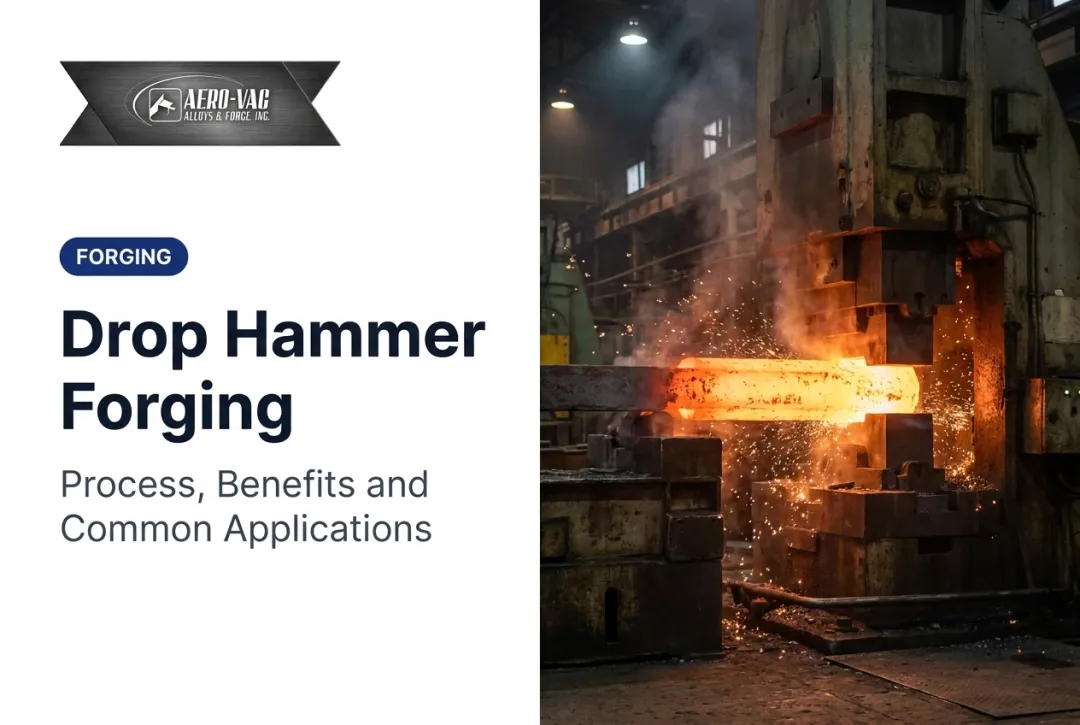
Hollow forging is a metal-forming process that creates tubular or hollow-core components by pressing or pounding heated metal around a mandrel. The mandrel defines the inner diameter as the outer surface takes shape under pressure. That differs from machining a tube from solid bar stock, where material is removed rather than formed.
That distinction drives performance. The Forging Industry Association notes that forging orients grain flow to match the part's shape, while machining cuts across that grain pattern, increasing susceptibility to fatigue and stress corrosion (FIA, 2024). A machined-from-solid tube has continuous grain running the wrong direction relative to load paths. A hollow forging doesn't.
The same principle shows up in stepped-hole shafts: machining away the inner zone of a forged part severs forming lines and reduces local strength and toughness. Boring a hole into an already-forged solid part gives up some of the benefit that forming the hole during forging preserves.
Open Die Forging Explained
Open-die forging uses flat or contoured dies (or a mandrel-and-saddle setup) that don't fully enclose the workpiece. It's the traditional method for large, low-volume, high-strength parts like rings, cylinders, and long hollow tubes.
For through-hole work, mandrel forging is the specific technique:
- Stepped mandrels produce stepped inner bores
- Wall thickness stays customizable along the full length
- Best fit for large parts where closed-die tooling cost isn't justified

Aero-Vac Alloys & Forge runs this open-die approach from high-cleanliness melt stock when grain structure and fatigue performance are critical.
The Hollow Forging Manufacturing Process
Material Selection
Alloy choice depends heavily on end use:
- Alloy steel (like AMS 6419 300M/4340M) for high-strength aerospace and defense shafts
- Stainless steel (303, 304/304L, 316, 17-4PH) for corrosion resistance in oil & gas or medical environments
- Carbon steel for general industrial and heavy-trucking components
Heating, Shaping, and Cooling
Forging temperature, deformation rate, and die temperature all affect how well a given alloy forges. Stainless grades are harder to work because they keep more strength at elevated temperature, which limits the maximum safe forging temperature before microstructural damage sets in.
During heating, borax and similar borate compounds often act as cover flux. They combine with surface oxides into removable slag, limit air oxidation, and help keep scale buildup down. That practice is common in steelmaking generally, not a hollow-forging-only requirement.
A documented three-step hollow-axle process illustrates the typical sequence:
- Partially heat tubular stock, often by induction
- Upset the heated section into a solid rod-like region
- Further upset that region into a flange shape
After shaping, heat treatment sets the final mechanical properties:
- Normalizing — heat above the transformation range, then air-cool
- Quench and temper — control hardness and toughness for the application

Finishing and Inspection
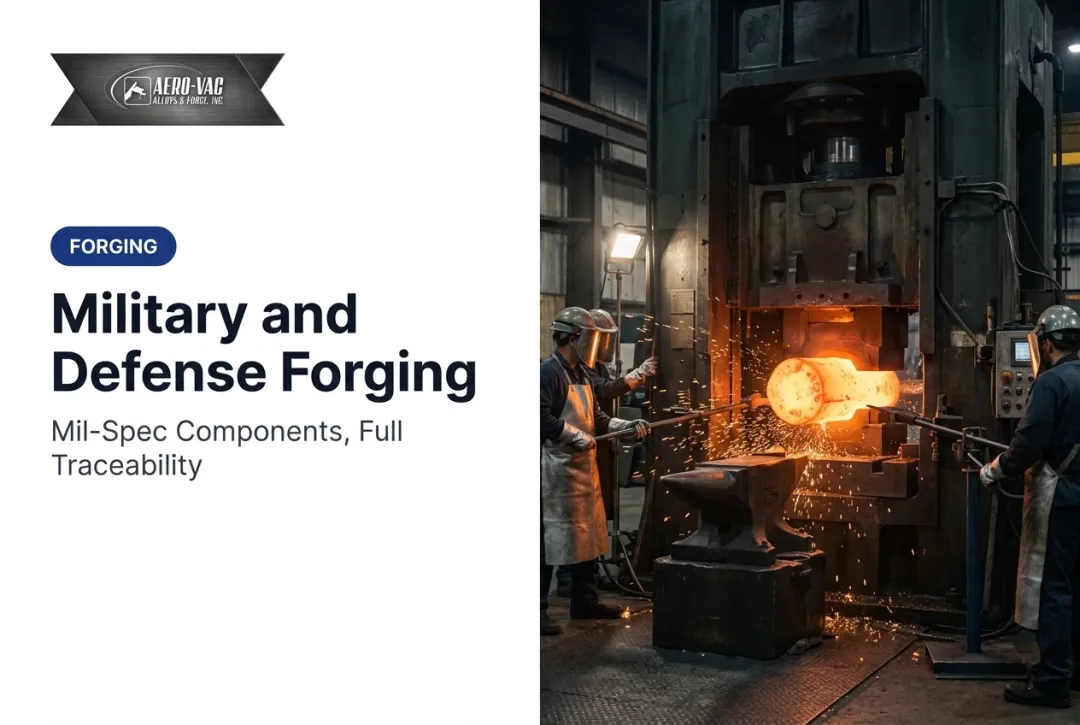
Once properties are set, aerospace and defense-grade forgings still need verified soundness and geometry. Standard practices include:
- Ultrasonic testing per ASTM A388/A388M, using straight- and angle-beam techniques on the finished forging
- Radiographic examination per ASTM E1742/E1742M, when internal defect detection is required
- Dimensional checks against the wall-thickness and bore tolerances in the spec
Key Benefits of Hollow Forging
Weight and Material Efficiency
Hollow forging improves material efficiency by removing metal from the shaft's neutral axis, where it adds the least bending resistance.
A 2026 wind-turbine rotor shaft case study found that a larger inner diameter raises bending section modulus for a given cross-section (WES, 2026). Where bending dominates the load case, that design improved material utilization—and the hollow-forged shaft came in 37% lighter than a cast equivalent.

Dynamic Performance
Lower rotational mass means lower rotational inertia. For parts that accelerate and decelerate often—gearbox shafts, motorsport drivetrains—that means quicker response and less energy spent spinning up non-working mass.
Fatigue Strength and Grain Retention
Unlike machined-from-bar parts, hollow forgings keep grain flow continuous around the bore. This matters most in:
- High-cycle rotating components
- Parts subject to stress-corrosion environments
- Applications where crack initiation at machined surfaces is a known failure mode
Usable Bore Space
The hollow cavity is usable space, not only a weight cut. Internal bores can route cooling lines, cables, or hydraulic fluid—something solid shafts cannot offer.
Industry Applications of Hollow Forgings
| Industry | Application | Evidence |
|---|---|---|
| Power generation | Wind turbine main/rotor shafts | 37% lighter than cast alternative |
| Heavy trucking | Axle shafts, driveline components | 26% weight reduction vs. solid design |
| Aerospace & defense | Landing gear components, structural tubing | Strength-to-weight critical |
| Oil & gas | Drilling components, pressure-rated tubing | Corrosion resistance required |
Wind and heavy trucking applications have the strongest documented process evidence. Aerospace and oil & gas hollow forgings rely more on general capability listings. Specify your exact bore-forming method with any supplier rather than assuming a "hollow shaft" was mandrel-forged versus bored afterward.
Sourcing the right alloy matters just as much as the forging method. Aero-Vac Alloys & Forge, an ISO 9001 and AS9100-certified manufacturing distributor supplying Boeing, SpaceX, and Lockheed, stocks forging-grade alloy and stainless steels. That inventory includes AMS 5629 material available in hollow forms, alongside rounds, rings, and custom shapes for these applications.
Choosing the Right Materials and Partners for Hollow Forging
Hollow forging only holds up when the alloy can take the work and the supplier can prove how the billet was formed, heated, and tested.
Materials That Challenge Hollow Forging
Not every metal forges well. Cast iron runs high in carbon, silicon, and phosphorus, so it turns brittle and cracks under forging pressure instead of deforming smoothly. High-carbon tool steels carry the same risk without tight process control.
Stainless steels keep more strength at elevated temperature, which narrows the safe forging window. Highly alloyed cold-work tool steels—high-carbon, high-chromium grades especially—need the same discipline and higher forging forces. There is no universal "hardest steel" ranking. Difficulty depends on the grade, billet condition, and equipment on hand.
Why Partner Selection Matters
A forging is only as good as the billet it starts from. Look for a supplier that offers:
- Documented mandrel or open-die forming (not just a "finished bore")
- Grade-specific heating and forging procedures
- In-house or partnered heat treatment to spec
- Third-party testing (ultrasonic, radiographic, magnetic-particle) before shipment
Aero-Vac Alloys & Forge supports those checks with in-house saw cutting for custom dimensions and independent testing to standards such as MIL-STD-2154 and ASTM E618. Just-in-time sourcing covers both stock billets and fast locates when the grade is not on the shelf.

Frequently Asked Questions
What is stronger, forged or machined?
Forging retains continuous grain flow oriented to the part's shape, giving better fatigue and impact resistance in most load cases. Machined-from-bar parts cut across that grain, which can increase susceptibility to fatigue cracking and stress corrosion.
Which metal is not ideal for forging?
Cast iron is a common red flag due to its brittleness from high carbon and silicon content. Certain high-carbon tool steels also carry cracking risk without tightly controlled heating and forging procedures.
What is the hardest steel to forge?
There's no single answer. Stainless steels are difficult because they hold strength at elevated temperature, narrowing the safe forging window. Highly alloyed cold-work tool steels require similarly specialized procedures and higher forging forces.
What is an open die forging?
Open-die forging uses flat or contoured dies (or mandrel-and-saddle tooling) that don't fully enclose the workpiece. It's the standard method for large, simpler geometries, including hollow tubes, rings, and cylinders.
Why put borax on metal when forging?
Borax acts as a flux, combining with surface oxides to form removable slag. This limits air oxidation and scale formation during heating, which helps protect the metal surface before shaping begins.